Long before oil, air conditioning or the skyline of Dubai, falconry was one of the few things that made survival in the desert possible, a hunting partnership between a Bedouin family and a trained bird that put meat on the table when little else could. That history has not disappeared, it has simply moved indoors to majlis gatherings, breeding programmes and a dedicated falcon hospital, while a simplified version of it, a bird on a glove for a quick photo, has become a fixture of the desert-camp tourist trail. A private falconry experience sits between those two worlds: closer to the real tradition than a camp photo stop, and far more personal than a scheduled group demonstration. This guide explains what that actually means, and where it fits into a private day in the UAE.
Falconry in the UAE: heritage, not a photo stop
The falcon on a handler's glove at a busy desert camp is real enough, but the encounter around it is usually brief and scripted: a minute or two for photographs, a short explanation, then the next coach group. That format has its place, but it is a world away from what falconry has actually meant in the Gulf for centuries, a working partnership between a falconer and a bird that took years to build, passed down within families rather than performed on a schedule.
A private falconry experience is built around that older idea rather than the photo stop. Instead of a queue and a fixed slot, a small private group spends real time with a falconer, watches a bird fly rather than simply pose, and hears the practice explained by someone who works with falcons rather than reciting a script between groups.
A heritage recognised well beyond the Emirates
Falconry is not a UAE invention, it is a shared Gulf and Central Asian tradition, and in 2016 UNESCO inscribed it on the Representative List of the Intangible Cultural Heritage of Humanity as a multinational nomination that includes the UAE alongside more than a dozen other countries. That listing recognised falconry as a living social practice rather than a museum piece, one still tied to identity, hospitality and the desert landscape itself across the region.
The UAE takes the practice seriously enough to have built infrastructure around it. The Sheikh Zayed Falcon Hospital in Abu Dhabi, established in 1999, is among the largest facilities of its kind anywhere, treating birds owned by private falconers as well as those bred for conservation. Many Emirati families still keep falcons at home and in the majlis, and a falcon can even travel with its own passport under UAE regulations, a small but telling sign of how seriously the tradition is still held.
What a private falconry session actually involves
The exact format varies with the falconer and the setting, but a private session generally follows the same shape:
- Time with a falconer who introduces the bird by name and background, not a generic script
- A close, unhurried view of the falcon on the glove, without a queue of other visitors waiting behind you
- A flight demonstration, the bird released and called back, showing the training rather than a static pose
- An explanation of how falcons were trained and used for hunting in the desert before modern life changed that need
- Space for photographs at your own pace, timed to the best light rather than a fixed slot on someone else's schedule
Where a private falconry encounter fits into a UAE day
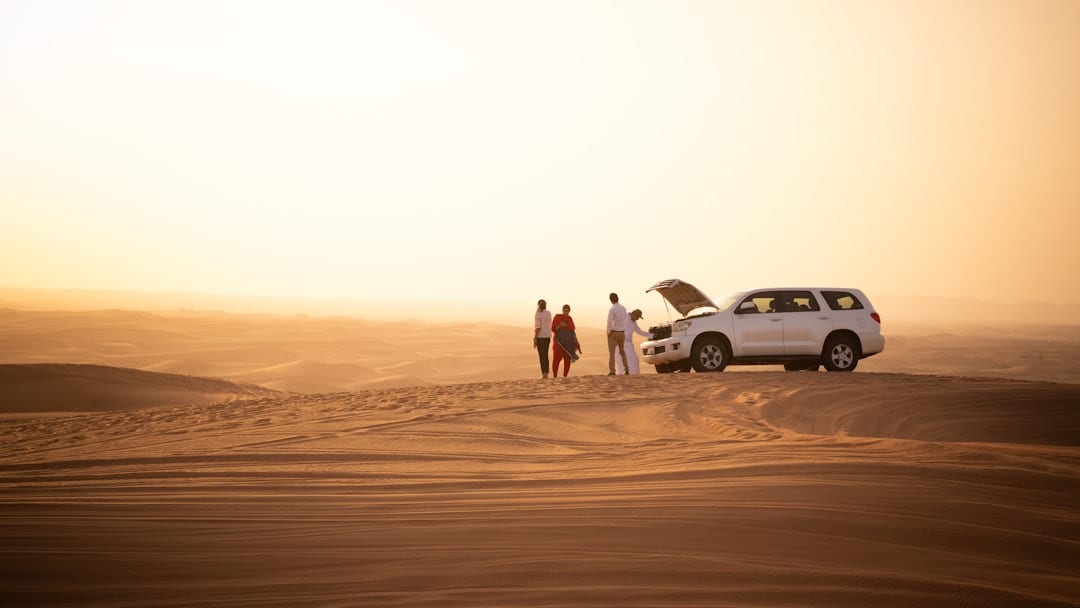
Falconry rarely stands alone as a booking, it is woven into a wider private desert day, and gett.tours already builds it into more than one route. Our private conservation safari includes a falconry demonstration as a core part of the programme, alongside a gentle drive through a protected reserve in search of oryx and gazelle, rather than as an optional extra. Our premium sunset safari takes the opposite approach, keeping falconry as a bespoke upgrade you can request when you enquire, added to the standard private camp evening for those who want to go further.
For a different angle on the same desert heritage, a private day at Mleiha in Sharjah pairs Fossil Rock and prehistoric tombs with the same golden dunes falconry has always belonged to, a reminder that the tradition and the landscape were never really separate.
A private encounter versus a fixed camp show
A group camp's falconry show runs on a schedule set for the whole camp, not for you: a fixed time, a fixed distance from the bird, and a narration aimed at a crowd rather than a conversation. A private session removes most of those constraints. Timing can move to catch the softer light of early morning or late afternoon, the group is small enough that everyone gets a proper view rather than a phone held up over someone's shoulder, and questions get real answers from someone who actually works with the bird, rather than a recorded-sounding script repeated between groups.
Planning a private falconry day
The cooler months, roughly October to April, are the most comfortable for any time outdoors in the desert, falconry included, and the same early-morning or late-afternoon light that flatters photographs also tends to suit the birds best. Beyond that, there is little to prepare, loose, comfortable clothing and a willingness to stand reasonably still near a working bird cover most of it. Gett.tours does not sell falconry as a standalone ticket, it is arranged as part of a private desert day, so the most useful step is to say on WhatsApp which route interests you, the conservation safari with falconry built in, or the premium safari with it added as an upgrade, and let us build the rest of the day around it.
Falconry in the UAE runs far deeper than the quick photo stop offered at most desert camps, it is a centuries-old partnership between falconer and bird, recognised by UNESCO, backed by a dedicated hospital in Abu Dhabi, and still kept alive in Emirati homes and majlis gatherings today. A private falconry experience, whether built into a conservation-style safari through a protected reserve or added as an upgrade to a premium sunset safari, replaces the fixed schedule and crowd of a camp show with real time, a proper flight demonstration and a falconer who actually answers your questions. Paired with a wider private desert day, it is one of the more quietly authentic ways to meet a tradition that shaped this landscape long before tourism did.