Sharjah sits directly next to Dubai, yet it tells a different story about the Emirates. Instead of record-breaking towers, it offers more than twenty museums, a fort-guarded heritage quarter and a corniche mosque that welcomes visitors of every faith. UNESCO named it the Cultural Capital of the Arab World back in 1998, and the title still fits: this is where the country keeps its manuscripts, its calligraphy, its restored courtyard houses and its oldest souk. A group coach tour tends to rush past all of it in an hour. A private day, with your own guide and vehicle, lets you actually spend time in the museum galleries, walk the old lanes at your own pace and, if you like, carry on into the desert at Mleiha before the light fades. This guide walks through what Sharjah offers, what a private day covers and when to go.
Sharjah, the UAE's cultural capital
Sharjah is the third-largest city in the Emirates and, in cultural terms, arguably the richest. Where Dubai built upward and outward with glass and steel, Sharjah invested in museums, libraries, art foundations and heritage restoration, and the emirate has kept that identity even as its neighbours raced toward the record books.
It is also a more traditional place. Sharjah is dry, meaning alcohol is not served anywhere in the emirate, and dress and public behaviour lean noticeably more conservative than in Dubai. For travellers curious about that side of the country, and about the history behind the postcard image of the UAE, Sharjah rewards a slower, more attentive visit rather than a quick photo stop.
Sharjah Museum of Islamic Civilization
Set inside a converted nineteenth-century souq building on the waterfront, with a golden dome that catches the light over the lagoon, the Sharjah Museum of Islamic Civilization is the single best introduction to the emirate's cultural weight. Its two floors move through Islamic faith, science and the arts, from finely painted ceramics and calligraphy to astrolabes and navigational instruments once used across the Islamic world.
The collection rewards context more than it rewards speed: a good guide can connect a single astrolabe or manuscript to the wider story of the Islamic golden age, when scholars in this part of the world were mapping the stars and translating Greek philosophy centuries before Europe caught up. Walked through properly, the museum turns from a quiet gallery into one of the most quietly impressive stops in the whole country.
Al Noor Mosque and the corniche
On the shore of Khalid Lagoon, along the Buhaira Corniche, Al Noor Mosque is one of a handful of mosques in the Emirates that welcomes non-Muslim visitors outside prayer times. Its twin minarets and Ottoman-inspired domes are striking from across the water, and inside, the calm, patterned interior offers a rare, respectful look at a working place of worship.
Modest dress is required, and abayas are typically available for guests who need them, so a private guide can simply arrange the visit around the right hours and the right etiquette. Afterwards, the corniche itself is worth the walk: lagoon views, fountains and a promenade that fills gently with local families once the afternoon heat eases.
Heart of Sharjah, the old quarter and its souks
Heart of Sharjah is the emirate's restored historic district, a cluster of coral-stone, wind-tower courtyard houses centred on Al Hisn Fort, once the ruler's residence and now a small museum of its own. Walking its narrow lanes feels closer to how the town looked before oil than almost anywhere else in the Emirates.
Two souks anchor the quarter. Souq Al Arsah, the oldest in the country, is a low, shaded lane of small shops selling antiques, spices and textiles, built to a scale that predates air conditioning entirely. A short walk away, the Blue Souq, known locally as the Central Souq, is unmistakable for its twin blue-tiled towers and trades in gold, carpets and souvenirs on a much larger, more modern scale.
- Al Hisn Fort, the restored former residence of Sharjah's rulers
- Souq Al Arsah, the oldest souk in the UAE, built from coral stone
- Restored courtyard houses now housing calligraphy and heritage museums
- The Blue Souq (Central Souq), famous for its twin tiled towers
Mleiha desert, a natural extension of the day
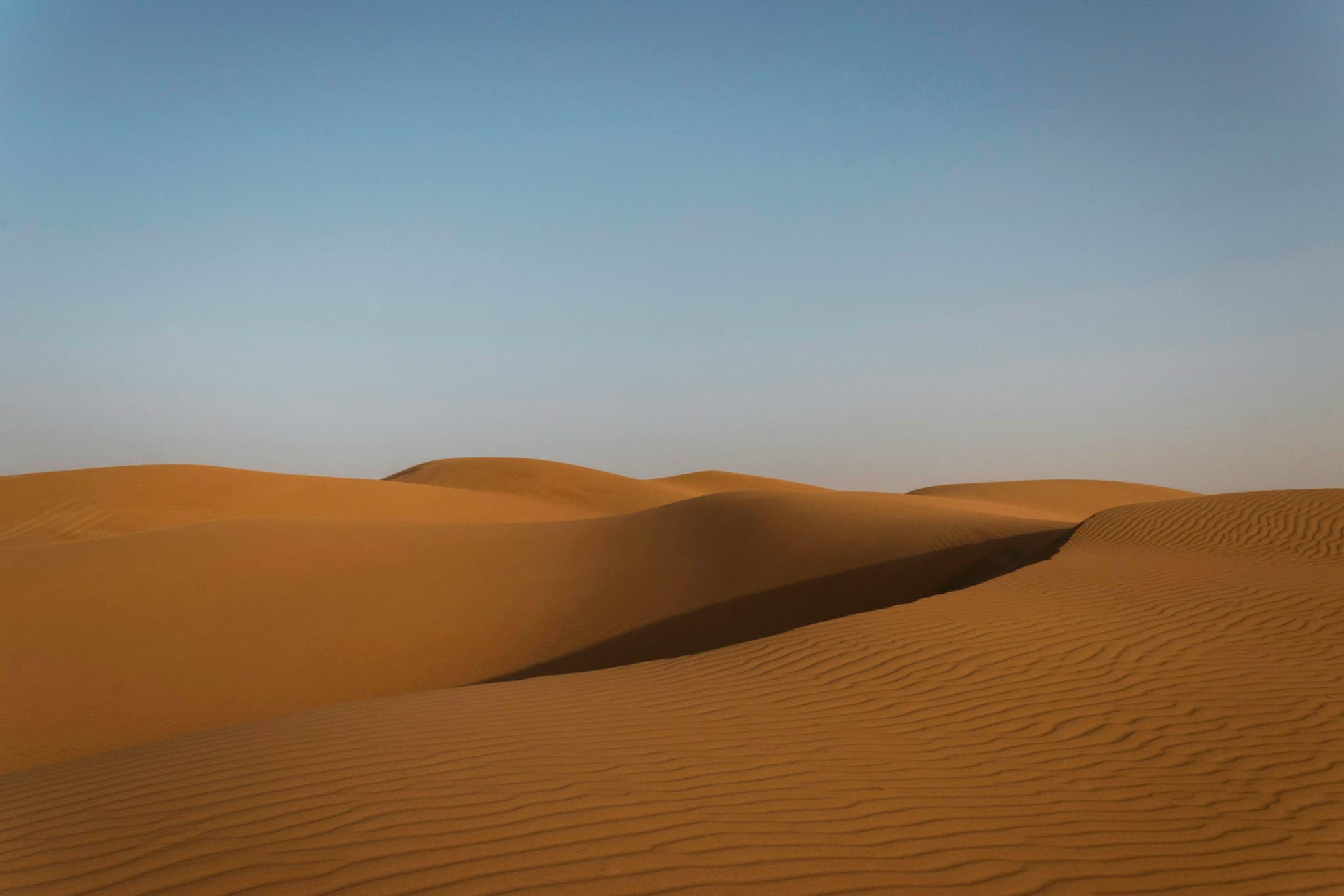
About forty-five minutes inland from Sharjah city, the Mleiha desert adds an entirely different chapter to the day. The Mleiha Archaeological Centre sits near sites that have yielded Bronze Age tombs and, at the Faya cave nearby, some of the oldest evidence of human presence outside Africa, set against a landscape of soft red dunes rather than city streets.
It is not essential to the Sharjah city visit, but it pairs naturally with it: museums and souks in the morning, the desert and its dunes toward late afternoon, when the light turns gold and the heat eases. A private guide can build the two into a single, unhurried day rather than two separate trips.
The best time to visit
As across the Emirates, the cooler months from roughly October to April are the most comfortable for Sharjah, when walking between the museum, the corniche and the old souks is genuinely pleasant rather than something to endure. Mornings tend to work best for the museums, leaving the corniche and Al Noor Mosque for the softer late-afternoon light.
In the hotter months, the museums and covered souks stay comfortable thanks to air conditioning, so the day still works well if the outdoor stretches, the corniche walk and any time in Mleiha, are shifted to the cooler edges of the day. A private guide can simply rearrange the order around the season.
Booking a private day in Sharjah
Sharjah suits a private format especially well, because so much of its appeal sits in details a coach tour has no time for: a manuscript worth a closer look, a quiet minute in the mosque courtyard, an unhurried browse through Souq Al Arsah. With your own guide and vehicle, you set the pace and the order, and skip anything that does not interest you.
A private day also handles the practical side smoothly: a comfortable transfer from your hotel in Dubai, a guide who can explain local etiquette and dress expectations before you arrive at the mosque, and the flexibility to add Mleiha or another northern emirate if you would like more than a single stop. Message us on WhatsApp with your dates, and we will build a private Sharjah day around what interests you most. For a group-format option, gett.travel keeps the general Sharjah guide.
A short drive from Dubai, Sharjah offers a different, more reflective side of the Emirates: the Sharjah Museum of Islamic Civilization, Al Noor Mosque on the Buhaira Corniche, the restored Heart of Sharjah quarter with its old fort and souks, and the option to carry the day on into the desert at Mleiha. It rewards time and attention rather than a quick photo stop, which is exactly why a private guide and vehicle suit it so well. Message us on WhatsApp with your dates, and we will arrange a private Sharjah day built around what you most want to see.