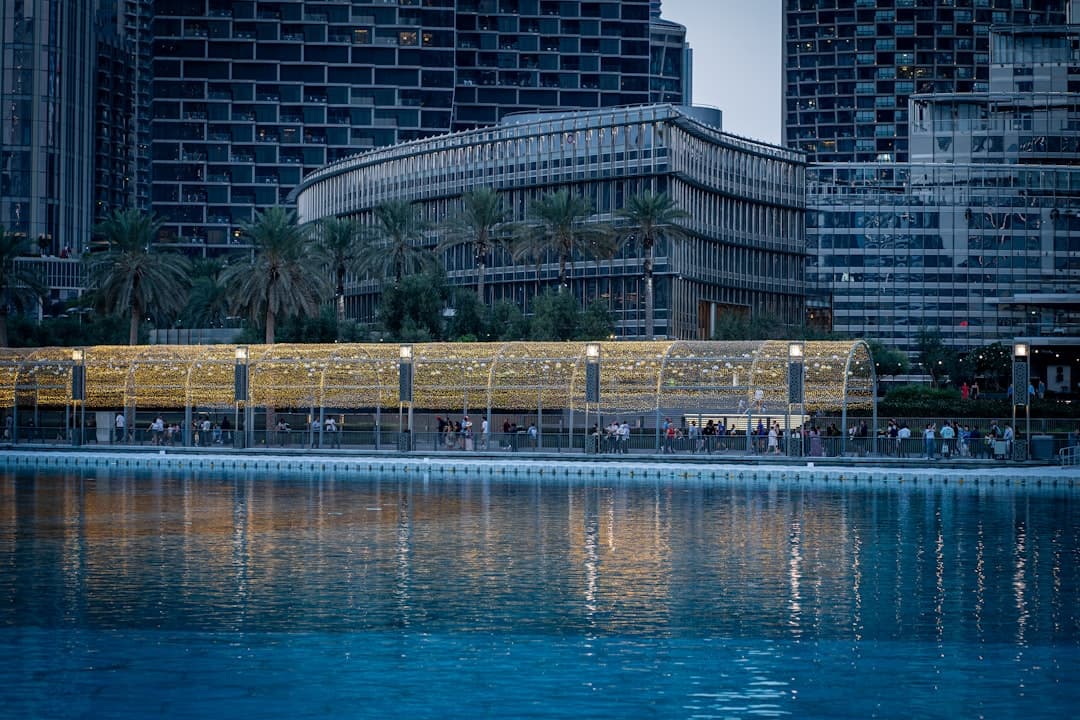
Dubai has spent a decade adding new ways to move through the air, and in 2026 a genuinely new option joined them: a commercial air taxi network of electric, piloted, 4-seat aircraft flying fixed hops between a handful of vertiports across the city. Booked through a smartphone app much like ordering a car, the service links Dubai International Airport with vertiports in Downtown Dubai, Dubai Marina and Palm Jumeirah, turning a journey that can take around 45 minutes by road into a flight of roughly 10. For a private-tour guest used to a driver, a quiet cabin and a schedule built entirely around their own day, this raises a fair question: does flying beat driving, or does a private transfer still hold the advantage once the whole trip, not just the minutes in the air, is weighed up?
What the Dubai air taxi service actually is
The network uses small electric aircraft, piloted rather than autonomous for now, each carrying a handful of passengers alongside the pilot. Flights run between a limited set of vertiports rather than anywhere in the city: one at Dubai International Airport, and others in Downtown Dubai, Dubai Marina and Palm Jumeirah, with more locations expected to join as the network matures through 2026.
Booking works through an app in much the same way as ordering a car, though seats are limited and flights run on a schedule rather than being available the instant a guest wants one. The aircraft are quiet compared with a helicopter and built to fly a fixed short hop rather than a scenic loop, which makes the service a point-to-point transfer first and a sightseeing experience only incidentally. A broader roundup of Dubai's new openings in 2026, from fresh attractions to transport launches like this network, is collected in gett.travel's guide to Dubai's new openings.
Where the air taxi wins: pure travel time
The headline advantage is the one the network was built for. A hop from the airport to a Palm Jumeirah vertiport takes around 10 minutes against roughly 45 by car on a normal traffic day, and the gap only grows during Dubai's peak congestion windows. For a guest on a tight schedule, arriving for a lunch reservation, a yacht departure or a same-day flight connection, a fixed short flight removes road traffic from the equation entirely.
That predictability is worth as much as the time saved itself. A private car can also move fast when the roads are clear, but only the aircraft is immune to an accident on Sheikh Zayed Road or a jam building around a major event.
Where a private VIP transfer still wins
An air taxi solves one specific leg of a day, not the whole itinerary, and this is where a private transfer keeps its long-standing advantages:
- Door to door, not vertiport to vertiport. A private driver collects a guest from the hotel lobby, the yacht marina berth or the villa gate and delivers them to the actual destination; an air taxi passenger still needs a car at both ends to close the gap between the vertiport and wherever they are actually going.
- No fixed departure schedule. A private transfer leaves when the guest is ready, waits through a delayed dinner or an extended desert safari, and adjusts instantly if plans change; an air taxi flies on a booked slot.
- Groups and families travel together. 4 seats cap who can fly on one aircraft; a private vehicle keeps a family, a couple or a small group of friends in one cabin for the whole day.
- Luggage, without a vertiport walk. A driver loads bags directly from the kerb; an air taxi passenger still carries luggage through a vertiport terminal.
- Coverage beyond a handful of vertiports. A desert safari camp, a golf resort or a residential villa community sits nowhere near a vertiport, so most VIP itineraries still depend on a private car for at least part of the day, often all of it.
- Privacy for the whole journey, not just the flight. A private car keeps a conversation, a business call or simply a quiet moment private door to door, without a shared cabin or a walk through a public vertiport lounge.
The itinerary that actually benefits from both
The two are not really rivals for most VIP guests; they solve different parts of the same day. A guest landing at the airport with meetings that afternoon might take the air taxi straight to a Downtown vertiport for the guaranteed arrival time, then step into a private car already waiting to reach the actual office or hotel. A yacht charter departing from a Dubai Marina berth, a private desert safari camp off the highway, or a villa community on Palm Jumeirah's fronds are all destinations a private transfer reaches directly and an air taxi cannot, since none of them sit on a vertiport.
For most full-day private tours, the practical answer is straightforward: a private car and driver remain the backbone of the itinerary, with an air taxi hop worth considering only for the specific airport-to-city leg where a guest wants the fastest, most exclusive way to skip Dubai's road traffic. Guests who want the flight itself to be part of the experience, not just a way to get somewhere, should look at a separate private helicopter tour over Dubai: unlike the air taxi it is not tied to a fixed route between vertiports and is built for a skyline panorama rather than a short A-to-B hop.
Choosing between the two for a VIP day
A single traveller making one short airport-to-Downtown hop with no luggage and a guaranteed arrival time to protect is the clearest case for the air taxi. Everyone else, families, groups, guests heading to a yacht, a desert camp or a villa, or anyone whose day includes more than one stop, is better served building the whole day around a private car and driver, which is exactly how a Dubai premium car tour or a private desert safari is arranged: one vehicle, one driver, door to door, for as long as the day requires. Travelers weighing a shared, group-format transfer instead can browse the excursions-with-transfer guide for Dubai on gett.travel.
Guests staying along Palm Jumeirah or planning a speedboat trip past Atlantis will find a private transfer reaches the marina or the villa gate directly, something no vertiport network, however fast, is built to do.
Dubai's new air taxi network is a genuine leap for short, fixed hops between a handful of vertiports, and for the right traveller, one person, no luggage, a tight schedule, it beats sitting in road traffic. But most VIP days do not start or end at a vertiport; they start at a hotel lobby, a yacht berth or a villa gate, and for that a private car and driver still does what no aircraft network yet can: door to door, on the guest's own schedule, for the whole day.